
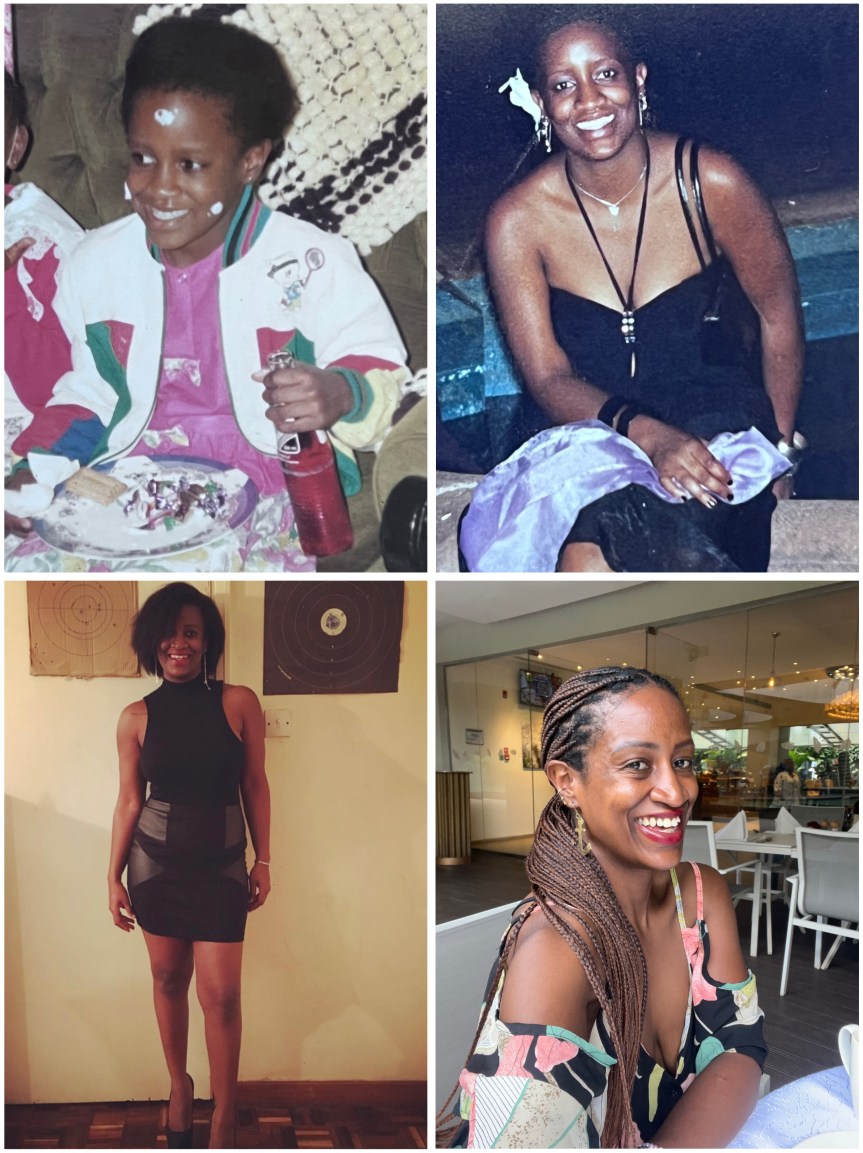
To the rest of the world, March 8th is International Women’s Day. But to me this day has always been, and will always be, my mum’s birthday first and International Women’s Day second.
Before I understood what today represents, I was being raised by the kind of woman this day was created to honour.
I say all the time it is no coincidence that my mum was born on International Women’s Day, as she was the quintessential woman who embodied what it means to be one with every fibre of her being.
I experience this day twofold: as a woman, like every other woman in the world, and as a motherless daughter, a particularity I share with my siblings.
I believe certain ages call you into yourself. For me, 38 is that age.
This International Women’s Day, I am 38 – an age that holds both my birthday and my late mum’s (August 3rd and March 8th) mirrored within it – and I cannot help but reflect on the woman I am becoming because of her.
At 8, I Was Beginning.
Like a typical 8-year-old girl, I was curious, forming friendships, learning right from wrong, and beginning to explore independence while still needing reassurance.
I was a geeky child who loved school and consistently ranked among the top three in my class. I lost myself in books, played with abandon, and ruled over my siblings with the confidence of a bossy firstborn.
But even as my independence began to bloom, my world still revolved around the woman who birthed me.
Because unlike a typical 8-year-old girl, I was a traumatised child, yet the innocence of childhood shielded me from that reality until I became aware of it as a teenager.
I grew up in a fearful and violent household, with a father who was simultaneously a source of safety and a threat.
The sole breadwinner, he bred chaos, pain and heartbreak, yet his presence also provided a fragile sense of security.
From him I learned that turning to a caregiver for protection could result in harm, and it was he who birthed my Fearful-Avoidant Attachment style.
My mum was the queen of sandcastles he destroyed, his fists smashing into her and into every attempt she made to build a home of love, joy, goodness and laughter for her children.
Even then, I carried a tiny version of the woman I would become, shaped by her safety, her security, and her protection.
At 18, I Was Discovering.
Like a typical 18-year-old new adult, I was stepping into adulthood, figuring out identity and values, deepening friendships, and testing the balance between independence and guidance.
I was no longer a girl, but not yet a woman. I could legally vote. I could legally drink. I could legally have sex, but I was still a virgin.
I dated boyfriends, made memories and mischief with girl friends, danced until dawn, and revelled in the thrill of having my whole life ahead of me, eager for everything it had to offer.
Standing at the edge of everything I did not yet know, I was stepping on my mum’s toes as I learned to dance between the freedom I wanted and the guidance I still needed.
Learning that dance often brought conflict. My mum became someone I lied to, fought with, and even disliked, but ultimately still loved.
But unlike a typical 18-year-old new adult, the trauma of my childhood had already made its home in my body.
The previous year, during my final year of high school, I began having difficulty walking. Day by day it worsened, until one day I simply could not walk anymore.
I was admitted to hospital, where doctors ran test after test trying to determine what was wrong. Every result came back the same: physically, there was nothing wrong with me.
Eventually it was concluded that the problem was psychological. What I was experiencing was conversion disorder, a condition in which emotional trauma manifests in the body as physical symptoms such as paralysis or blindness.
Like a cancer, the trauma from my childhood had progressed from benign to malignant.
I began with physiotherapy at the hospital and added sessions with a counsellor, the first steps in a therapy journey that has continued, on and off, for the past 20 years.
At 18, I did not know how to manage, let alone live with, the mental illnesses born from my childhood trauma: PTSD, OCD, anxiety, and, occasionally, depression. All I knew was that I felt sad and empty inside.
In an attempt to feel something – anything – I experimented with self-harm (cutting) and with being an exotic dancer.
My mental health struggles were only beginning, and 20 years later there is still no clear end in sight. I have made peace with that now, but at 18 it utterly undid me.
Ironically, it was in the midst of my undoing that I began to see my mum more clearly. Her resilience. Her quiet endurance. Her ability to hold softness and strength in the same hand. The way she bent without breaking.
I saw how much of my foundation she had built. Anything I am is because she was first.
At 28, I was Caregiving.
Like a typical 28-year-old woman, I was more self-aware, confident in my values and boundaries, focused on meaningful relationships, and climbing the corporate ladder.
Two years shy of 30, financial independence felt urgent, and I constantly reassessed whether my path matched the life I was building.
I had always been close with my mum, but at 28 we had also become best friends. It was both my greatest honour and my greatest burden.
Because unlike a typical 28-year-old woman, I was also my mum’s caregiver after she became paralysed from the waist down due to medical negligence in the treatment of stage IV breast cancer that had metastasised to her spine.
From bathing and dressing her to changing her adult diapers, my days revolved around helping her do the things her body could no longer do.
To care for those who once cared for us is one of life’s highest honours, but over time a battle raged inside me. A battle between wanting to care for my dying mum and wanting to live my life.
There were days I hated being her caregiver, and on those days I hated myself for hating it.
Beneath that hate lived the terror of not knowing how long my mum had left. Few things are harder than watching the love of your life fight so hard to live. A fight you cannot quite tell whether they are winning or losing.
By mothering my mother, I began to see her for who she really was: a woman just like me, with her own virtues and flaws, many of which I have inherited.
At 38, I am Becoming.
I am unpacking the lessons, triumphs and scars from the good, the bad and the ugly of my first 37 years.
I am dedicating the time and energy to work on myself because I want to truly know myself and understand my patterns.
38 is an invitation to examine what behaviours, habits and patterns no longer serve me and to begin changing them.
What do I need to let go of?
What do I need to do differently?
What wounds from my past do I still need to heal?
They say life begins at 40. But for me, it begins at 38.
This age is not just a number to me. It is the numerical container that holds the woman who came before me and the woman I am still becoming.
International Women’s Day celebrates women everywhere. Today, I celebrate each of us—and the dearly departed birthday girl who made me who I am.
The women who shape us never really leave us. I am a motherless daughter, yet also a daughter becoming a woman shaped by her mother. That is the legacy I carry forward.
 Lwile the Leo
Ma, I was hoping to be the first one to comment (I was not too sure I would be the first one to read your blog but I would like to believe I fall in the top 1percentile) because I know how much 38 means to you. You have written about it before and as a long-term reader of yours, this post falls nothing short of what Lwile would have written – raw, reflective and looking to grow through what you went through. Your writing, oh my your writing, draws me into your world, with words coiffed so beautifully. I admire your writing, I admire your consistency and your go-getter attitude for anything you put your mind to.
Hugs.
LikeLike